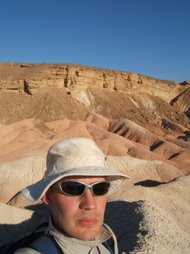
Monday 3rd March Yes, my incredible jet-set lifestyle never lets up. Here I am, in the famous Moon Beach resort in hot and gravelly Sinai once again. This time Paul Woodman and I are leading a field trip, all by ourselves, for a crew of petroleum industry types who are working in the North Sea and the Gulf of Suez. Our task is to give them an overview of the structural style and stratigraphy of the Suez rift, for which we’re getting paid consultancy rates. This is probably the first trip to Sinai that I’m making more money than Sayed, our driver. For Paul, it’s a useful chance to look around the area before he starts writing up his PhD in earnest. For me, the best geologist is the one who has seen the most rocks, so it’s good to keep looking.
We fly from Manchester to Cairo via Amsterdam, and take in the bar in Manchester’s terminal 2. It’s bloody awful. They’ve run out of most of the beer they have (no cask, of course), it costs £6.25 for two pints, and the place is strewn with dirty plates and glasses. The Murphy’s pub at Schipol is far nicer, and I get a pint of Murphy’s and a chip butty. We arrive in Cairo at 2am, which is never any fun, but negotiate the visa queue, passport queue, baggage claim, customs and taxi drivers without too many problems. We manage to get a couple of hours sleep at the apartment of some friends of Paul’s in Maadi, Sayed picks us up at 8am, and we drive to Moon Beach, arriving at 12:30 and just in time for lunch. A fairly uneventful trip, as they go, the highlight being an articulated lorry passing us at about 100 km/h with a burst tire strewing rubber shreds all over the carriageway. As far as we can tell, the driver doesn’t stop, but these things have ceased to surprise me much.
We eat goatburgers (nominally beef, but we have our suspicions) and chips, and spend the afternoon scoping out the sites we’re going the take the trip to. At the first one, a pipeline is being laid by the side of the main road, and the area seems to have become a work site and general rubbish dump, but we think we can spend some time looking at early syn-rift stratigraphic relationships there. The second stop is part of Paul’s study area, and as such is plagued with Bedouin marijuana (‘bango’ in Egyptian Arabic) growers. Last time we were here, there was a very large bango field, but as usual the Bedouin were happy enough once they knew who we were and what we were doing. We need to check out the area to make sure that no-one is going to think we’re army or police and shoot us. This is the kind of thing I still can’t quite believe I’ve found myself doing. Today, though, the area is quiet, not a soul to be seen, and it seems that we can use this site as well.
By now, on a good two and a half hours sleep, I’m done thinking for the day, so we repair to Moon Beach, where I watch the sun go down over Wadi Araba. Even this has a purpose, though: I want to know what time sunset is, so we don’t have to expose ourselves to the hideous danger of driving at night in Egypt.

Wednesday March 5th
So far so good. We spent yesterday checking out some of the sites we’re going to visit on the trip, to make sure the roads are OK and that there is no bango. It’s all good, except on Thursday we have to go through the police checkpoint outside Abu Zenima. We don’t particularly want to do that, because Sayed doesn’t have a desert pass and we only have tourist passes, but a road is blocked and we don’t have any options.
The field trip people arrive today. We go out in the morning to look at one of the sites we’ll visit, and arrive back at Moon Beach at 11am. The trip is supposed to have left Cairo at 8am, so we expect them here around 11:30 or so. They eventually show up at 2pm. Apparently, there was some misunderstanding with the drivers about who needed to be picked up at Cairo. Then there was a delay at the Ayun Musa checkpoint. This now seems to be a corrupt checkpoint, with the excuse to stop the jeeps relating to a fire extinguisher. I doubt that 1% of the vehicles that go through that checkpoint have working fire extinguishers. They also checked passports. I assume a bribe was being angled for.
We manage to get away from Moon Beach in short order and take in a couple of field stops. The last stop is the summit of Gebel Hammam Faraun, where you can get a panoramic view across the Hammam Faraun fault block. The road to the summit was originally built by the UN and there is now a Vodaphone mast there, so the road is quite well maintained, although very steep and winding. Even so, two of the jeeps get punctures on the way up, the drivers are very slow (“Tourist drivers,” says Sayed dismissively, “not for geologists”) and the ensuing delay leaves us driving through dusk to get back to Moon Beach. The companies are very keen that we get back before dark, for safety reasons (which will make sense if you’ve ever travelled on Egyptian roads in the dark). But, there’s no harm done, although it’s 6:15 when we get back and I’m wiped out. I think I’m a little sunstruck, or I’ve picked up some mild bug. I have a headache and don’t much feel like eating.
Even so, I manage a couple of beers with the field trip people, and eat some Moon Beach buffet, and I feel a little better. The only problem is that Moon Beach has no international phone line at present, so I have no way of contacting Jolan and letting her know I’m OK (and letting me know that she’s OK). Paul let me use his phone to send a text to our landline last night, but I don’t know if that is going to work and I’m worried. But as it stands, there’s nothing I can do about it. I have no mobile and there certainly isn’t any internet here. I think that I’m going to have to get a mobile, and that annoys me unreasonably. Clearly I’m tired, so I turn in.
Thursday March 6th
Wadi Nukhul today, which is really my show, given that I’ve spent the last two and a half years working on it. We start by looking at some minor faults in the footwall of one of the major block-bounding structures. There’s a spectacular detachment horizon where the faults flatten out into a clay-rich layer. We go to the Wadi Nukhul east face, and as we drive we see a Bedouin hiking through the desert with a Kalashnikov. Who knows where he was going and why he needs a gun for the journey. He waves at us, in our fleet of brand new black jeeps, cheerily enough. The east face is one of the best bits of geology you’re ever likely to see. The participants are impressed.
Then we go for a walk through the type section of the Nukhul Formation, but no-one seems particularly interested in that. Perhaps none of the companies are targeting it, or perhaps it’s the heat, but it’s not setting pulses racing. In the afternoon, we look at the Nukhul fault zone itself, and look at the west face. It’s spectacular stuff, and colourful, and I would say that there are few better examples of rift initiation stratigraphy and structure anywhere.
Friday March 7th
Today is ‘Wadi Baba and the faulted Thebes’, as some wag has christened it. This is spectacular geology that can’t fail to impress, so we’re on solid ground. In the morning we look at the Nukhul Formation (rift initiation). In contrast to Wadi Nukhul, the Nukhul Formation here lies directly on Thebes limestone, and no Abu Zenima Formation is present. We look at a section near the footwall crest of the Nezzazat fault,where only the top offshore/shoreface facies of the Nukhul are deposited, and another section in the mouth of Wadi Baba where some of the estuarine tidal facies are developed, although they seem to be much more wave-dominated here. We also look at the syn-rift lower Rudeis Formation, which has fairly extreme lateral variations in thickness and facies. The best part of the day, though, is the afternoon, when we walk along the main Baba fault and then over what we call the cableway col. The cableway was built to carry manganese ore from the basement to the edge of the Baba Markha plain, where a narrow-gauge railway took it to Abu Zenima. We get spectacular views of the growth syncline in the hangingwall of the fault, and the reverse faults associated with it. We do this at the hottest part of the day, and it’s sweaty work, but well worth it. There’s enough mobile reception here for our resident reservoir engineer to receive a wrong number from the UK. Then we walk down the lower Rudeis section, which is much more proximal here, full of conglomerate and with spectacular slump units.
We finish the day at the cableway terminus, where both Israel and Egypt have billeted soldiers at one time or another. The buildings now are largely destroyed with walls pock-marked by bullet holes. The cableway itself is no longer functional, the Leeds steel rusting gently in the baking sun. There is graffiti in both Hebrew and Arabic, and the field trip participants take a few pictures.
At the checkpoint before Abu Zenima, one of the secret policemen wants to stop us, but his colleague tells him we’re from an onshore drilling rig that is on the Baba Markha plain not far from the checkpoint. Sayed says the magic word ‘petrole!’ and they let us through. Another good day, and no more checkpoints now until we head to Cairo.
At dinner, a couple of the guys tell me that they’ve got a lot out of the trip, more than most trips they’ve been on, which is good to hear. You want people to get something out of it.
Sunday 9th March
The final day of the trip goes OK, although we haven’t really rehearsed what we’re going to do at the last stop. I try to summarise what we’ve done on the trip, but I’m totally knackered, and it doesn’t come over too well. The rocks we see are largely calc-arenites, not good reservoir rocks, and the reservoir engineer gets glummer as the day progresses.
We get back to Cairo, safe but not exactly well. I can’t claim that I don’t deserve it, having stayed up drinking vodka (which I never drink) pretty much all Saturday night after the end of the trip. Paul manages to get me up in the morning, and we’re on the road by 9am. I don’t sleep, amazingly enough, but I’m in a bit of a stupor most of the way. My voice has more or less gone, a combination of yelling at field trip participants and staying up late.
Just after we get to Suez, I see some stopped traffic up ahead, and something lying on the road. I imagine one of the hundreds of overloaded vans and pick-up trucks has lost part of its load, a common enough occurrence. As we get closer, I realise that it’s something much worse. The bundle lying in the road is a dead body, looking pretty shapeless and mercifully covered with a blanket by someone. A motorcycle is lying forlornly near the shoulder about a hundred yards up the road. All the colour drains from Sayed’s face; I’m looking pretty colourless anyway. An ambulance is just arriving, but it’s clear that there’s nothing they can do. We pull over a little way up the road, where an articulated lorry and a few cars are parked, but of course, there’s nothing we can do to help either. Sayed tells us the motorcycle rider was trying to pass between two trucks: one of the trucks clipped him, and he fell underneath the other one. The rest of the trip passes more or less in silence.
We get back to Cairo OK, and are staying with friends of Paul’s in Maadi. We visit GUPCO, where Paul worked for a while, get a bite to eat, and take a nap. I’m about ready to get home. We watch a movie and some DVDs of ‘Extras’, and snatch another 40 winks before the 4:15 am (really) KLM flight to Amsterdam. Except, when we get to the airport at 2 am, we discover that the flight is delayed for ten hours. KLM put us up in a hotel across from the airport. Paul is quoted 25 LE for the ride, all of a couple of hundred yards. In Maadi, 5LE will get you pretty much anywhere you need to go. There was really only one possible response. ‘Magnoon!’ [crazy!] says Paul, and we walk.
We get to Amsterdam Monday afternoon, and have a soothing pint of Murphy’s and a bacon and egg sandwich. I eventually make it home 11 hours late, but at least I make it home.
 El Tor, the town where we stayed, at sunset.
 Downtown El Tor.
 Fossilised burrows in Miocene syn-rift rocks. There's a lot of this in the study area, which usually means that structures that would help to understand the depositional environment are obscured.
 Part of the field area. To the right are rocks of the Precambrian basement. In the foreground, a major normal fault separates those Precambrian rocks from Nubian sandstone, Eocene carbonate units, and Miocene syn-rift calc-arenites.